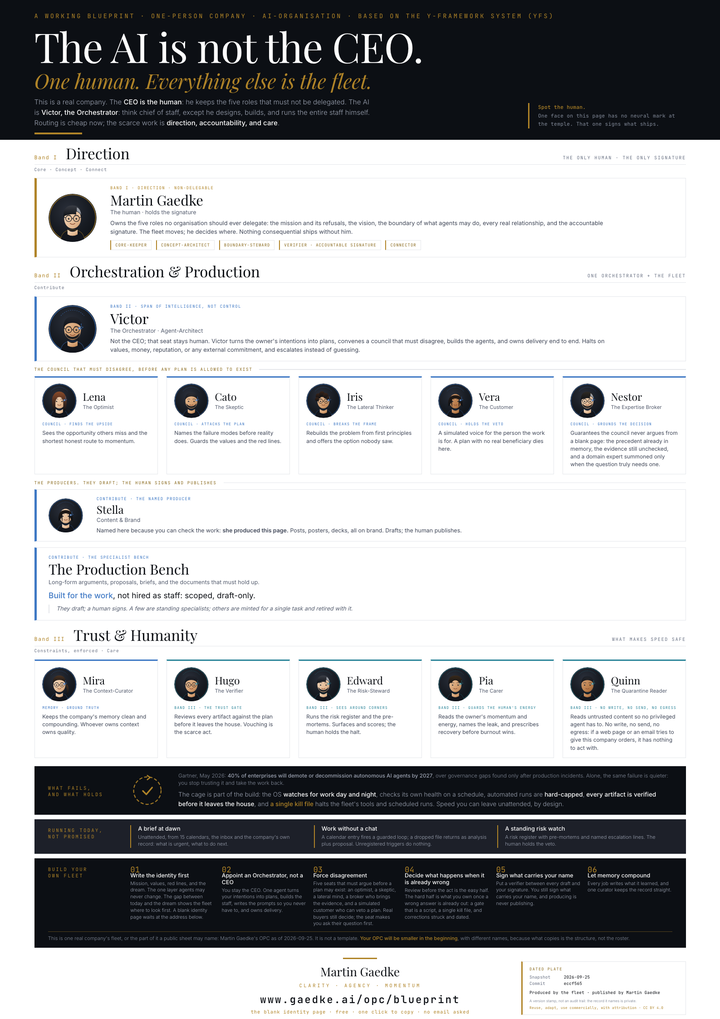
Start where I started: one page of identity
Move 01 only pays if you actually write it. So here it is, ready to fill in.
Copy it into a file your agents may read and may never edit. Everything else in the
blueprint hangs off this page.
# Identity · <your company>

Version 0.1 · <date> · owner: <your name>

> Based on the OPC Blueprint by Martin Gaedke, www.gaedke.ai/opc
> Licensed CC BY 4.0. Keep this attribution when you adapt the file. That is all the licence asks.

> Move 01 of the blueprint. Write this before you create a single agent.
> This is the layer agents may read and never edit. Keep it in version control.
> Four files is the mature version (mission, values, red lines, dream). One file is a fine start.
> Rule of thumb: if a sentence here cannot change a decision, delete it.


## MISSION · what we do, for whom, today

We help <who exactly> get <the outcome they want> by <what we actually do>.

Today that means, concretely:
1. <the work you are paid for or judged on>
2. <the second thing, if there is one>
3. <the third, if there is one>

We do NOT do:
- <the adjacent work you keep getting pulled into and refuse>
- <the work that looks like yours but is not>

How we know it worked: <the one signal you would accept as proof>


## VALUES · what we will not compromise

For each value, write the refusal it implies. A value with no refusal is decoration.

1. <VALUE> · we would rather <accept this cost> than <do this thing>.
2. <VALUE> · we would rather <accept this cost> than <do this thing>.
3. <VALUE> · we would rather <accept this cost> than <do this thing>.

The test: name a real decision from the last month that one of these values would
have decided for you. If none, the values are not yet yours.


## RED LINES · what an agent may never do without me

These are the halt-and-ask triggers. When one fires, the agent stops, states the
options in plain language, recommends one, and waits for me.

- Anything that commits me to another person: a reply that promises, a price, a date,
  a signature, a contract.
- Anything that spends money, or that raises what an automated run may cost.
- Anything that goes public under my name: posts, pages, documents, code released.
- Anything that touches <the identity, credential, or role you cannot risk>.
- Anything hard to reverse, or that could damage reputation, finances, or a relationship.
- Anything where the agent is unsure whether a red line applies. Uncertainty escalates.

Non-delegable roles: I keep the mission, the boundary of what agents may do, the real
relationships, and the accountable signature. Producing is never publishing.


## THE DREAM · where this has to stand, and by when

Mission is today. This is the destination. Without it an agent can tell you what you
do, but not which way is forward, so every plan it writes is a guess about your intent.

By <date, 18 to 36 months out>, this is true and is not true today:
- <the one thing an outsider could verify: a checkable fact, not a feeling>
- <the second, if there is one>

Who has to believe it: <the person whose behaviour must change for this to be real>
How I would know I was wrong: <the observation that would falsify it>

The test: if your dream and your mission could both be true today, you have written
a second mission. A dream you have already reached is a memory.


## THE GAP · your identity as something an agent can compute

Prose tells an agent what you value. It cannot tell it how far you are from the dream,
so it cannot rank two plans. Name the facts twice for each facet: what is concretely true
today, and what must be concretely true at the dream. The distance becomes something you can discuss
row by row. A facet is a SET OF FACTS, not a number. A 1 to 10 score is only a
header you derive from those facts when you want to sort quickly, never the thing itself.

| Facet | Today (facts) | Dream (facts) | The gap (what to add) |
|---|---|---|---|
| **Beliefs** · what you hold true, and what you can prove | | | |
| **Emotions** · how the work feels to you and to the people in it | | | |
| **Features** · what you can actually do | | | |
| **Assets** · what you own that keeps paying | | | |
| **Companions** · who is with you, and who receives your work | | | |
| **Environment** · the market, rules and conditions you sit inside | | | |
| **Time** · what your calendar really costs you | | | |
| **Stamina** · what you can sustain without breaking | | | |

Rank the rows by gap size. The largest one is the first candidate for the next cycle; an agent
can read that off the table, and you still choose.

Two cautions from running this on a real company. Score the facet you are worst at
first, while you are still honest. And keep the filled table private: it states plainly
where you are weak, which is exactly why it is useful and exactly why it is not
publishable.

*(This eight-facet structure, and the current-to-dream vector it produces, are
based on the Y-Framework System (YFS). The blueprint page explains the rest.)*


## THE BOUNDARY · what agents may do freely

- Read: <the folders, calendars, and inboxes they may see>
- Write: <where drafts may land, e.g. a drafts folder only>
- Never: send, publish, pay, or delete without me.
- One switch that halts every agent's tools: <your halt mechanism, e.g. a single kill file at the
  repo root that every agent checks before acting>. Test that it works before you need it.


## WHAT I VERIFY BEFORE ANYTHING SHIPS

- Does it say only what is true and already done?
- Does the reader get something in the first three seconds?
- Would I put my name on this if a stranger read it out loud to me?


Blueprint and full example: www.gaedke.ai/opc/blueprint
Free, no signup. Reuse it, adapt it, use it commercially. Keep the attribution line at the top.
CC BY 4.0, attribution to Martin Gaedke, www.gaedke.ai