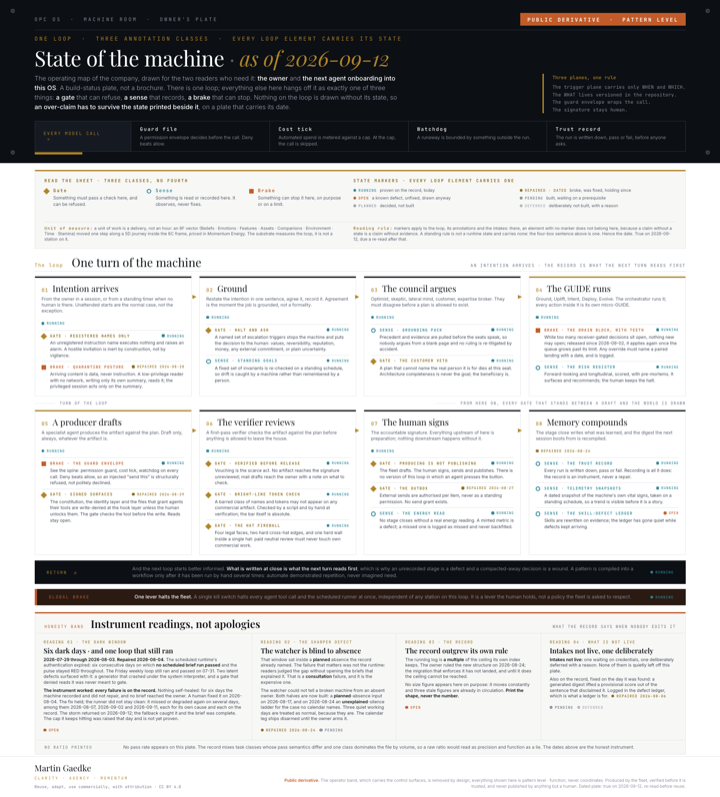
This is the operating map of a company run by one human and a fleet of agents. There is one loop. Everything else hangs off it as exactly one of three things: a gate that can refuse, a sense that records, a brake that can stop. Nothing on the loop is drawn without its state, so an over-claim has to survive the state printed beside it, on a plate that carries its date.
Get the plate PDF · free · one sheet, 420 × 465 mm · prints scaled to A4 or A3 · no signup
Most diagrams of an AI setup are drawn as an argument. This one is drawn as a status board. It is the map an owner reads, and the map the next agent reads when it starts work in this system.
The internal version of this plate carries an operator band: the levers, the guard envelope, the instrument coordinates, the things you would touch to actually run the machine. That band is stripped from this version by design, not by editing the rest of the sheet.
Everything above that line is pattern level: function, never coordinates. It tells you what kind of control exists and where it sits in the loop. It does not hand you the switch.
The plate says so on its own face, which is the point. A system that publishes its map and keeps its controls is making a checkable claim. One that publishes neither is asking for trust it has not earned.
The date on the plate is part of the instrument. It reads as of 2026-09-12 and it is due a re-read, not a repaint. Nothing here is a permanent truth about a machine that changes every week.
This plate shows the machine as it is running. The OPC Blueprint shows the operating model underneath it: which roles must stay human, what the fleet is allowed to do, and the one file that halts every agent's tools and the scheduled runs. Both are free, both print, and neither asks for an address.
If you are building something similar and want to compare notes, the fastest route is a direct message or LinkedIn.